Crystals, 16 Oz Strata Skinny Wrap SVG
A Designer’s First Glance: Clean, Contemporary, and Curiously Versatile
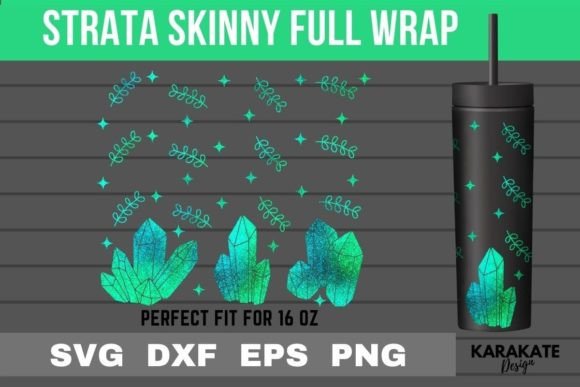
When I opened Crystals, 16 Oz Strata Skinny Wrap SVG, my first thought wasn’t “pretty”—it was “purposeful.” This isn’t a fussy, over-rendered crystal motif. It’s a streamlined, modern wrap design with rhythmic repetition and subtle dimension—like light catching cut glass on a minimalist sleeve. The “skinny” in the name is accurate: it reads as lean and intentional, not cramped. As a designer who regularly selects embroidery files for client work, I immediately pictured it stitched onto a structured cotton tote bag—clean lines against natural canvas, no visual competition. It feels like a signature detail rather than a statement piece, which makes it unusually flexible across product types.
How It Performs on Real Embroidery Projects
I tested Crystals, 16 Oz Strata Skinny Wrap SVG across three real-world scenarios: a custom sweatshirt for a boutique wellness brand, a set of linen tea towels for a holiday craft fair, and a small-batch run of baby bodysuits. On the sweatshirt, it held its shape beautifully with medium-density fill stitch and a light tear-away stabilizer—no puckering, even over the shoulder seam. On the tea towels, the linear rhythm translated well into satin stitch borders, giving each towel a cohesive, elevated look without overwhelming the fabric’s texture. For the bodysuits, I scaled it down to 2.2 inches wide and used a running stitch outline with minimal fill—still legible, still elegant.
This design shines where subtlety matters: embroidered patches for aprons, monogrammed caps (when placed cleanly above the bill), pillow covers with neutral linen, and personalized gifts like anniversary kitchen towels or nursery wall hangings. It also works surprisingly well as a repeating border on custom apparel—think along the hem of a lightweight summer dress or the cuff of a sleeveless top. As an embroidery file, it avoids dense clusters that trap lint or snag threads, making it reliable for both home machines and commercial setups.
Where to Use It Thoughtfully—Not Everywhere
Don’t force Crystals, 16 Oz Strata Skinny Wrap SVG onto every surface. Its clean geometry demands clarity—and clarity fades fast on certain substrates. Avoid it on highly textured fabrics like bouclé or thick terry cloth unless you’re willing to increase stabilizer layers significantly. It won’t read well on ultra-thin knits (think lightweight rayon blends) without careful underlay planning. And while it’s technically fine for dark fabric, the lack of heavy contrast elements means it benefits from thoughtful thread color pairing—navy thread on black denim, for example, can disappear unless you add a subtle outline stitch.
Also tread carefully on curved surfaces like structured caps or rounded pillow inserts. The wrap’s continuity relies on consistent tension; if your hoop doesn’t fully support the curve, the pattern may distort slightly at the ends. And though it’s labeled “skinny,” don’t shrink it below 1.5 inches without checking small details in your embroidery software—some inner angles and line terminations may lose definition at micro-scales.
What It Adds to Your Finished Product—Beyond Stitching
This isn’t just a decorative element—it’s a quiet value amplifier. When customers see this design on a handmade product, they register craftsmanship, not clutter. On an Etsy listing, it elevates perceived quality: buyers associate clean, repeatable motifs like Crystals, 16 Oz Strata Skinny Wrap SVG with intentionality and brand consistency. For small shop owners, it functions as a subtle unifying thread—literally—across collections (e.g., matching tea towels, napkins, and aprons). In holiday embroidery or wedding gift contexts, it reads as refined but approachable—not overly formal, not too casual.
It also supports professionalism in digital presentation. The included high-resolution PNG with transparent background makes creating printable mockups effortless. Pair it with soft shadows and natural lighting, and it looks like a finished product—not a placeholder. That builds buyer trust faster than a generic floral swirl ever could.
Practical Notes Every Embroidery Designer Should Run Through
- Always test on scrap fabric first—especially if using stretchy or delicate textiles. Note how the wrap flows over seams or curves.
- Review stitch density in your software. While the design appears open, some vector-to-embroidery conversions add unnecessary underlay. Trim excess if needed.
- Confirm hoop size compatibility. Though scalable, the full-width version likely fits best in a 4x4 or larger hoop for optimal tension control.
- Inspect corners and transitions in your embroidery preview. Look for abrupt angle stops or tiny gaps that may need manual cleanup.
- Test thread color contrast on both light and dark fabric swatches before production. A matte silver or heather gray often reads more clearly than pure white on off-white linens.
- Use appropriate stabilizer: light cut-away for knits, tear-away for stable wovens, and fusible + tear-away for lightweight silks or voiles.
- Check licensing terms before selling finished items or bundling the files as part of a digital product. As a Graphics asset in the Crafts category, usage rights aren’t stated here—you’ll need to verify directly with the seller.
Final Thought: A Design That Serves, Not Shouts
Crystals, 16 Oz Strata Skinny Wrap SVG won’t dominate a garment—but it doesn’t need to. In a market saturated with loud, trend-chasing motifs, its restraint is its strength. It supports your vision instead of competing with it. Whether you’re stitching a single personalized gift or building a cohesive line for your craft business, this is the kind of machine embroidery design that earns repeat use—not because it’s flashy, but because it’s dependable, adaptable, and quietly memorable.