You’re My Cup of Tea
A Designer’s First Glance: Charm Without Clutter
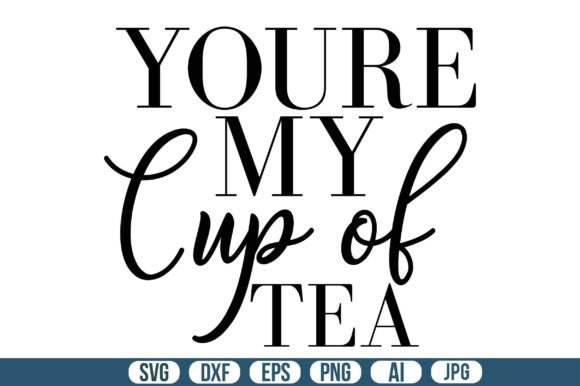
Opening You’re My Cup of Tea feels like unrolling a well-loved sketchbook page—warm, intentional, and quietly confident. It’s not fussy or over-rendered; the teacup sits center-frame with soft curves, a gentle steam swirl, and clean, friendly lettering that wraps around it like a whispered inside joke. As a designer who’s stitched hundreds of phrases onto baby onesies, boutique totes, and holiday kitchen towels, I immediately sense its rhythm: balanced negative space, consistent line weight, and a visual pause where the eye can rest. This isn’t just a phrase—it’s a mood anchor. It belongs on something you’d hand to a friend after a long week, not something you’d scroll past in an Etsy feed.
Real-World Stitch Test: That Tote Bag Moment
Last week, I prepped You’re My Cup of Tea for a custom linen tote bag order—a small-batch gift for a local tea shop’s loyalty program. I loaded the SVG into my embroidery software, resized it to 4.2” wide (a safe fit for most 5x7 hoops), and ran a test on scrap medium-weight cotton canvas. The stitch density held up cleanly—no piling, no skipped satin stitches—and the lettering stayed legible without needing outline reinforcement. Steam swirl? Crisp. Teacup rim? Smooth. No jagged vectors or stray anchor points. That tells me the original digitizing was thoughtful—not rushed, not auto-traced. For sweatshirt embroidery or baby onesies, I’d recommend keeping it under 4.5” to preserve clarity on textured or stretchy fabric. On a cap? Probably too wide unless simplified—but as a front-panel design on a relaxed-fit unstructured cap? Absolutely viable with minor scaling.
Where It Shines—and Where to Pause
You’re My Cup of Tea excels in projects where warmth and approachability matter most: embroidered pillow covers for nursery decor, tea towel sets sold at craft fairs, personalized aprons for bridal shower gifts, or minimalist patches sewn onto denim jackets. Its clean silhouette translates beautifully to both light and dark fabrics—especially when paired with muted thread colors like oatmeal, slate gray, or sage green. But be mindful: the delicate steam curl and fine interior cup details won’t resolve cleanly on ultra-thin jersey or heavily napped fleece without added stabilizer. And while it works well on stable woven fabrics (linen, cotton duck, twill), avoid placing it directly over seams or curved areas like elbow joints on sleeves—those subtle curves demand a flatter surface for even stitch laydown.
Commercial Use Considerations for Craft Businesses
If you’re an Etsy seller or small shop owner building a cohesive brand around handmade home goods or personalized gifts, You’re My Cup of Tea fits neatly into your design assets library—but only if your licensing allows commercial embroidery use. Since this is a digital download with SVG, DXF, and EPS files, confirm whether redistribution or resale of the *digital file* is permitted before listing it as part of a “design bundle” or embroidery kit. For finished products—like embroidered mugs, totes, or baby blankets—you’re generally clear to sell, but always verify terms. I’ve seen too many crafters pause mid-production because they assumed vector = commercial-ready, only to find usage limits buried in fine print.
Design Notes Every Embroiderer Should Check
- Test first on scrap fabric—especially if using textured weaves or blends. Linen’s slubs can catch fine satin stitches.
- Review stitch density before stitching on lightweight knits. High fill stitch counts may cause puckering without cutaway stabilizer.
- Confirm hoop size compatibility. At full scale, it fits comfortably in a 5x7 hoop—but double-check your machine’s max dimensions.
- Inspect small details in your embroidery software: zoom in on the steam swirl and cup handle junction. Are anchor points smooth? Is there overscan?
- Try black-and-white mockups before committing thread colors. Contrast matters more than charm when stitching on heather gray or navy.
- Use proper stabilizer—tear-away for stable wovens, cutaway for knits or stretchy fabrics. Skip the iron-on for this one; heat can distort the delicate curves.
- Compare light/dark backgrounds visually. What reads as sweet on ivory linen may vanish on charcoal terry cloth without a shadow or outline.
Why This Design Builds Trust—Not Just Stitches
In a market flooded with generic “coffee lover” designs, You’re My Cup of Tea stands out by feeling human—not algorithmic. Customers notice that. When someone unwraps a tea towel embroidered with this phrase, they don’t just see a product—they feel seen. That emotional resonance lifts perceived value, supports premium pricing, and strengthens repeat engagement. For boutique owners, it reinforces brand consistency across seasonal collections (think: spring garden tea sets, cozy winter mug sleeves). For hobbyists gifting baby items, it adds sincerity without cliché. And for apparel decorators building custom lines, it’s versatile enough to pair with botanical motifs or stand alone with quiet confidence.
Final Thought: A Design That Works Quietly, Not Loudly
You’re My Cup of Tea doesn’t shout. It invites. It’s the kind of embroidery file you reach for when you want craftsmanship to speak louder than embellishment—when clarity, comfort, and quiet intention are the goal. It’s not built for maximalist bling or dense metallic fills. It’s built for real life: for hands holding warm mugs, for naptime on soft blankets, for small shops curating meaning alongside merchandise. As a working designer and embroidery reviewer, I keep it in my go-to folder—not because it’s flashy, but because it delivers, stitch after honest stitch.