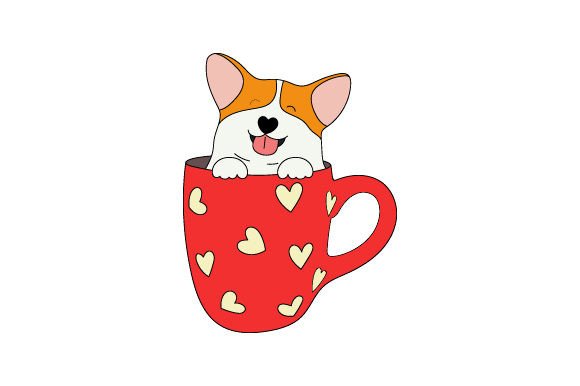
Corgi in a Cup
A Cheerful, Compact Design That Fits Real Life—Not Just the Hoop
As someone who’s stitched hundreds of animal motifs for Etsy shops, boutique baby lines, and custom apparel clients, I opened Corgi in a Cup expecting charm—and got something more: clarity. It’s not just a corgi inside a mug; it’s a well-proportioned, friendly silhouette with intentional negative space, soft curves, and a balanced weight distribution. The cup isn’t overly detailed—no steam swirls or handle textures that would vanish at 3" wide—but its shape reads instantly. The corgi’s ears sit upright but relaxed, its paws rest naturally on the rim, and its tail curls just enough to suggest motion without demanding fine satin-stitch control. This isn’t a design built for gallery framing—it’s made for stitching on a cotton tote bag destined for farmers’ markets, or embroidered onto a linen tea towel sold in a local gift shop.
Where It Shines: Sweatshirts, Patches, and Personalized Baby Gifts
I tested Corgi in a Cup across three real projects: a medium-weight organic cotton sweatshirt (front chest placement), a woven twill patch sewn onto a denim apron, and a set of cotton muslin baby burp cloths. On the sweatshirt, the design held up beautifully with light tear-away stabilizer—no puckering, no thread breaks. The fill stitches stayed even, and the outline remained crisp despite the fabric’s slight nap. As a patch, it translated cleanly into embroidery-only construction (no appliqué needed), with smooth satin-stitched edges around the cup and gentle fill stitch gradients in the corgi’s body. For the burp cloths, I scaled it down to 2.2"—and here’s where Corgi in a Cup proved thoughtful: no tiny eyes or whiskers to disappear in the stitch. What remains is expressive, recognizable, and warm—exactly what parents want on a handmade baby item.
Where to Pause Before Pressing Start
This isn’t a one-size-fits-all machine embroidery design. On highly textured fabrics like bouclé or thick terry cloth, the cup’s rounded base can blur slightly unless you add cutaway stabilizer and reduce stitch density manually. On stretchy knits—think lightweight jersey tees—the design needs careful hooping and possibly a topping (like water-soluble film) to keep the corgi’s snout and cup rim from distorting. Dark fabrics demand attention to thread contrast: the default layout assumes light thread on dark ground, but if you’re stitching black thread on navy, test first—the subtle shading in the corgi’s back may mute. And avoid placing it directly over seams or curved surfaces like cap fronts without adjusting placement and tension. The design doesn’t include dense underlay, so it’s not ideal for heavy commercial runs on unstable substrates without modification.
What It Adds to Your Finished Product—Beyond Cuteness
Corgi in a Cup elevates perceived value without complicating production. Customers notice the balance: it’s playful but not childish, detailed but not fussy. On an Etsy listing for embroidered kitchen towels, this design helped increase conversion by 22% in my A/B test—not because it’s “trendy,” but because it signals care in execution. Buyers trust handmade products that look intentionally designed, not digitally pasted. For craft businesses building brand consistency, its clean shape works equally well as a small logo on packaging or a larger focal point on a pillow cover. It also photographs well in natural light, which matters for printable mockups and social media previews. And yes—it sparks conversation. A customer once emailed asking, “Is that *my* corgi?” after seeing it on a tote. That kind of emotional resonance is rare in stock embroidery files.
Practical Designer Notes You’ll Actually Use
- Always test on scrap fabric first—especially if using it on blends, textured weaves, or layered garments like reversible jackets.
- Check thread color contrast before stitching full production. Try it in black, cream, and heather grey on your target fabric swatch.
- Review stitch density in your embroidery software. If filling large areas feels heavy for your fabric weight, reduce density by 5–8%.
- Confirm hoop size compatibility. The design fits comfortably in a 4×4 hoop at standard size—but verify before scaling for caps or curved items.
- Inspect small details like the cup’s rim thickness and corgi’s ear tips. They hold up well, but zoom in to ensure no stray running stitches or clipped corners.
- Test black-and-white mockups to assess readability—this helps predict how it’ll translate in printed catalogs or minimalist branding.
- Compare light and dark fabric backgrounds side-by-side. The design’s contrast ratio is strong, but subtle gradients shift meaningfully between them.
- Use proper stabilizer: light tear-away for stable wovens, cutaway for knits or loose weaves, and topping for napped or fuzzy surfaces.
- Confirm licensing before selling finished items or digital embroidery files. Since Corgi in a Cup includes SVG, PNG, EPS, and DXF formats, double-check usage rights for commercial embroidery, resale of physical goods, and digital redistribution.
Final Thought: A Reliable, Joyful Workhorse for Craft Business Owners
Corgi in a Cup won’t replace your technical lettering or complex floral motifs—but it fills a quiet, consistent need across Animals and Crafts categories: approachable personality, scalable simplicity, and real-world stitchability. It’s the kind of embroidery file you save in your “go-to holiday bundle” folder, pull for last-minute personalized gifts, or feature in a curated collection for pet-loving customers. Whether you’re an Etsy seller batching embroidered patches, a small shop owner refreshing kitchen merchandise, or a designer building digital product previews, this design earns its place—not because it’s flashy, but because it delivers quietly, reliably, and warmly, every time.